
Two Ways to Route the Same System
Most radon quotes read like a parts list, but the real decision is simpler: where does the pipe go? Interior vs. exterior radon mitigation comes down to the pipe’s path and where the fan sits.
Every active system does the same job. A fan pulls soil gas from under your slab or crawlspace membrane and vents it above the roof.
That job matters in Iowa. The state’s Iowa Radon Survey found that 71.6% of homes test above the EPA action level of 4 pCi/L, the largest share in the country, according to Iowa HHS. The EPA says a well-built system can cut radon by up to 99 percent.
Both layouts are standard in our residential radon mitigation work, and both can bring levels well below 4.0 pCi/L when they’re designed correctly. Below, we compare the two on looks, noise, Iowa winters and roofline rules, then show which homes fit each.
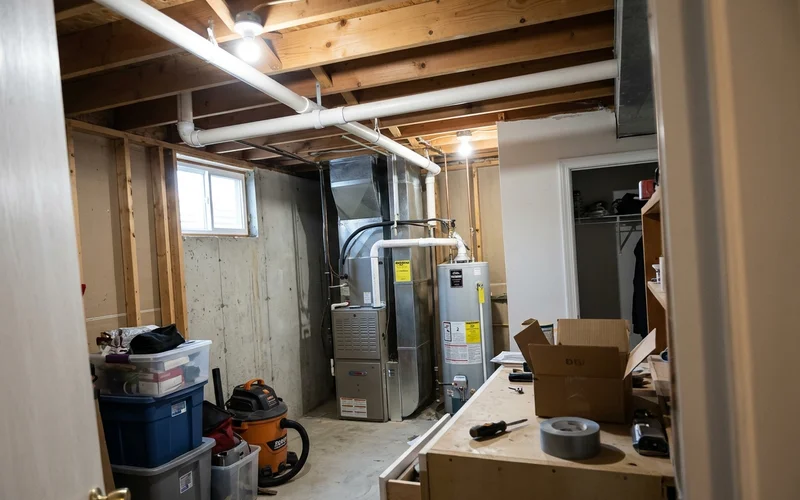
- Interior system: The pipe rises through the house, usually in a closet, utility chase or attached garage, and the attic radon fan sits up under the roof. Only the short exhaust shows above the roof.
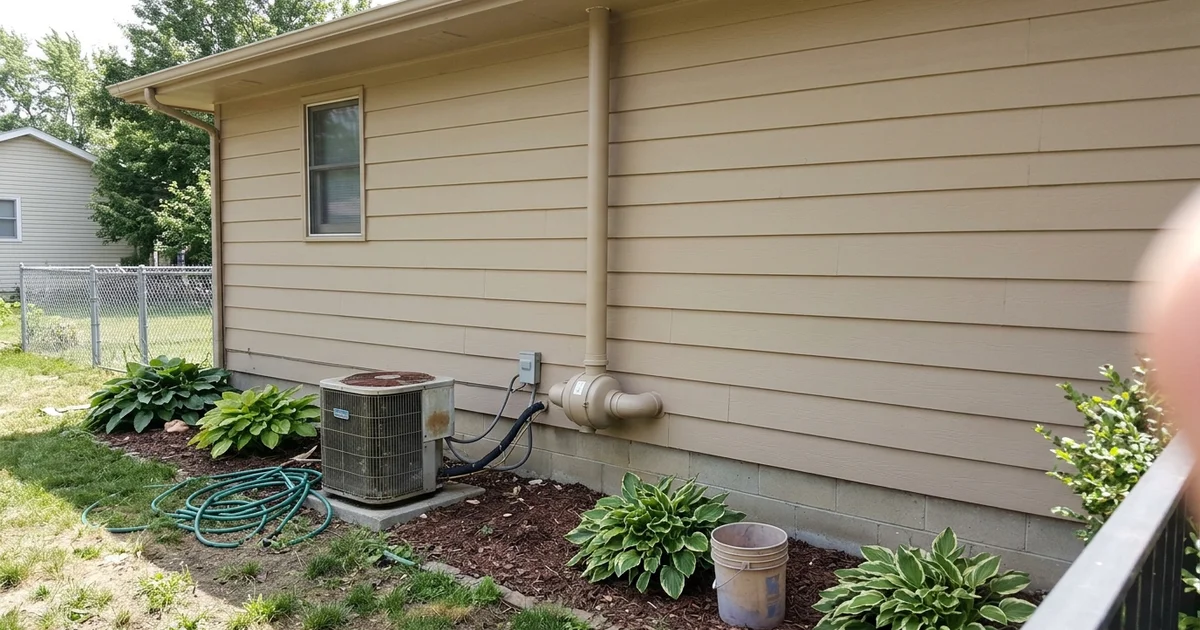
- Exterior system: The pipe exits through the rim joist or foundation wall, the fan mounts on the outside of the house, and the pipe runs up the exterior wall to above the roof edge.
The rule that doesn’t change
The fan must never sit in living space or a basement, and the exhaust must end above the roof edge. Whichever route you pick, the positive-pressure side of the system stays outside the area where you live. Fan makers like Fantech point to AARST/ANSI standards that allow the fan outside, in a properly vented attic, or in a garage with no conditioned living space above it.
Side-by-Side Comparison
Interior systems win on looks, quiet and fan life. An exterior radon system wins on install speed and on homes with finished basements.
| Factor | Interior system | Exterior system |
|---|---|---|
| Curb appeal | Pipe hidden; only a short stack above the roof | Pipe visible on the side of the house, can be painted to match |
| Noise in the home | Fan in attic, usually very quiet | Fan outside, quiet indoors; some hum near the fan outdoors |
| Finished basement impact | May need a chase through finished space | Little or no interior work beyond the suction point |
| Iowa winter freeze | Pipe stays warm, low freeze risk | Cold pipe, more condensation and freeze risk if poorly designed |
| Fan life | Protected from weather | Exposed to sun, snow and temperature swings |
| Install time | Can take longer in finished homes | Often quicker |
| Best fit | Attached garage, unfinished chase, attic access | Finished basements, slab homes, homes without an easy interior route |
The fan-life row is worth a second look. A 2004 paper from radon contractor WPB, covering its own installs from 1996 to 2004, found that outdoor fans tended to wear out sooner than attic fans. The authors tied that to condensation draining back past the motor, which is why a drain bypass matters on exterior jobs.
Exposure alone isn’t the problem. Major fan lines such as RadonAway’s RP Series are listed for indoor or outdoor use, so a well-built exterior setup is a legitimate choice.
Looks and Finished Space
Looks usually decide it, and interior routing keeps the facade cleanest. For many Des Moines homeowners, appearance is the whole conversation.
Historic neighborhoods like Waterbury, Sherman Hill and the East Village often favor interior routing, so the facade stays clean. In homes with a finished basement and no unfinished closet, an exterior system avoids cutting into drywall and ceilings. We can paint exterior pipe to match siding and run it along a back or side wall where it’s less noticeable.
Don’t treat an exterior pipe as a compromise. American Radon LLC notes that exterior systems are far more common than interior ones, so you’re choosing a mainstream layout.
Noise
Both layouts are quiet when they’re installed right, but placement matters. An attic radon fan above a garage is hard to hear anywhere in the house.
An exterior fan mounted outside a bedroom window can produce a low hum that some people notice at night. Most noise complaints, though, come from vibration traveling through the pipe and framing, not from the fan itself. ERASE Radon calls vibration transfer the most common cause of noise complaints, and a good design avoids it with three simple steps:
- Use the right pipe size, so air doesn’t rush through undersized pipe
- Add rubber isolation couplings at the fan
- Keep the fan and pipe from touching framing
Iowa Winters: Freeze and Condensation
Exterior systems carry more freeze risk in Iowa, and interior systems carry less. This is where Iowa homes differ from warmer states.
Soil gas is moist and roughly ground temperature. When it hits cold pipe, water condenses. In an interior system, the pipe stays inside heated space for most of its run, so condensation drains back down to the suction pit. In an exterior system, the pipe is exposed to January lows that average 17°F in Des Moines, according to Weather Spark.
Poorly designed exterior systems can collect water in the fan or build ice at the exhaust, which cuts airflow. Good design avoids that by:
- Sizing the pipe so air moves without excess condensation
- Sloping all horizontal runs back toward the suction point, at least 1/8 inch per foot, the minimum in the International Residential Code’s radon appendix
- Adding a condensation bypass at the fan when needed
- Keeping the exhaust opening clear, without screens that trap ice
Roofline Exhaust Rules
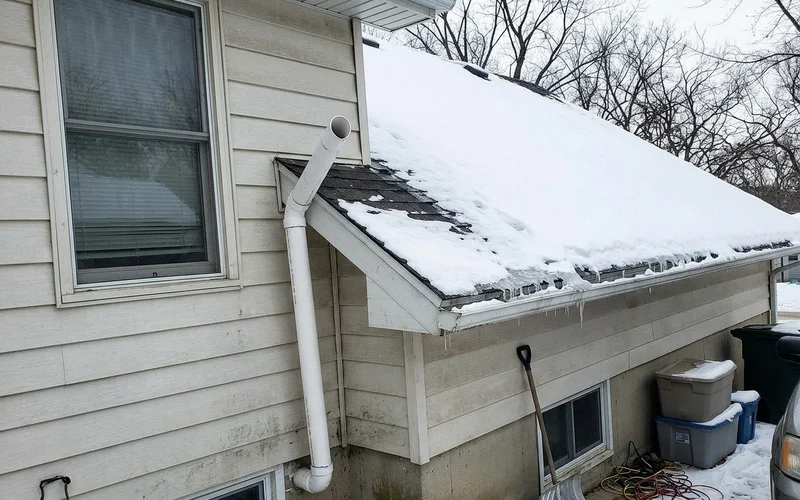
Yes, both systems must vent above the roof edge, and no layout gets an exception. Under ANSI/AARST guidance for residential systems, the exhaust should end above the eave, away from windows, doors and other openings, and at a distance from any opening that could let vented radon back inside.
The numbers are specific. EPA guidance, as summarized in a 2016 AARST conference paper, puts the discharge point:
- Above the eave line, pointing straight up
- At least 10 feet above the ground
- At least 10 feet from openings into the conditioned space, or at least 2 feet above any opening that’s closer
Indiana’s state inspection checklist adds that the exhaust shouldn’t blow straight onto walls or roof eaves. Exhaust at ground level or below a window isn’t acceptable, no matter how convenient. If a quote shows a short pipe ending at the side of the house, ask why.
Which Homes Suit Each Option?
Interior wins when you have an easy path through heated space. Exterior wins when you don’t.
Interior usually wins when:
- You have an attached garage the pipe can run through (the fan can’t sit in a garage with living space above it)
- There’s an unfinished storage room, closet or utility chase below attic access
- Curb appeal is a priority, as in historic districts
- You want the quietest result and the longest fan life
Exterior usually wins when:
- Your basement is finished and there’s no easy interior route
- The home is a slab-on-grade ranch with limited attic access
- You want the shortest install time
- The best suction point sits near an outside wall
Cost Differences
Neither option is always cheaper. Angi’s 2026 data puts a typical radon system at $800 to $1,300, and EPA’s Citizen’s Guide to Radon cites an average near $1,200, with typical prices running up to $2,500. Foundation type and home size drive much of that spread.
Routing shifts the price in smaller ways:
- Interior routing in a finished home can take more labor
- Exterior routing may need more pipe and fittings, and sometimes a condensation bypass
We often quote both when both make sense. For the full list of cost drivers, read our guide to radon mitigation cost in Iowa.
Choosing With a Specialist
Pick the route that fits your foundation, layout and attic access, then confirm it with a quote. How much you care about the outside of the house matters too.
During your quote, we’ll look at both routes and explain the trade-offs. Every system from our Des Moines radon mitigation team includes a post-mitigation test, a U-tube manometer (the small gauge that shows the fan is pulling suction) and our 5-year warranty on systems and installs.
If you own a small commercial building, the same routing questions apply. Fans like RadonAway’s RP Series are rated for both commercial and residential use.
Ready to compare interior vs. exterior radon mitigation for your property? Ask us for a quote, and we’ll walk through both routes with you.