
The Simple Answer
Test your home at least once if you never have. After that, retest every two years, and any time something changes in how your house meets the ground.
That matches the EPA’s advice in A Citizen’s Guide to Radon: retest at least every two years, even if you already have a system. Our radon testing service handles all of these, using continuous radon monitors that log your level every hour.
Iowa makes this more than a formality. Iowa is EPA Zone 1, and the Iowa Radon Survey found that 71.6% of Iowa homes test above the 4.0 pCi/L action level. Iowa’s home buyer and seller fact sheet puts the average indoor level at 8.5 pCi/L, compared with 1.3 pCi/L nationally.
Levels also shift as foundations settle and homes change. One test from years ago isn’t a permanent answer.
Your Radon Retest Schedule
Retest every two years as your baseline, and sooner when the house changes. Find your situation below to see the timing.
| Situation | When to test | Why |
|---|---|---|
| Never tested | Now | Only a test tells you your level |
| No system, last result below 2.0 pCi/L | Every 2 to 5 years | Foundations crack and settle over time |
| No system, result between 2.0 and 3.9 pCi/L | Follow-up or long-term test soon | Confirms whether your average is near the 4.0 line |
| Radon system installed | Every 2 years | Confirms the fan and seals are still working |
| After installing a new system | Post-mitigation test right away | Proves the system lowered your level |
| After finishing or remodeling a basement | After construction is done | New use of the lowest level and possible new cracks |
| After foundation, slab or sump work | After the work is done | Repairs can open new soil gas paths |
| After replacing the furnace or adding major ventilation | After the system is running | Air pressure changes affect radon entry |
| Buying or selling | During the inspection or before listing | Iowa Code 558A.4 disclosure and buyer confidence |
Make it easy to remember
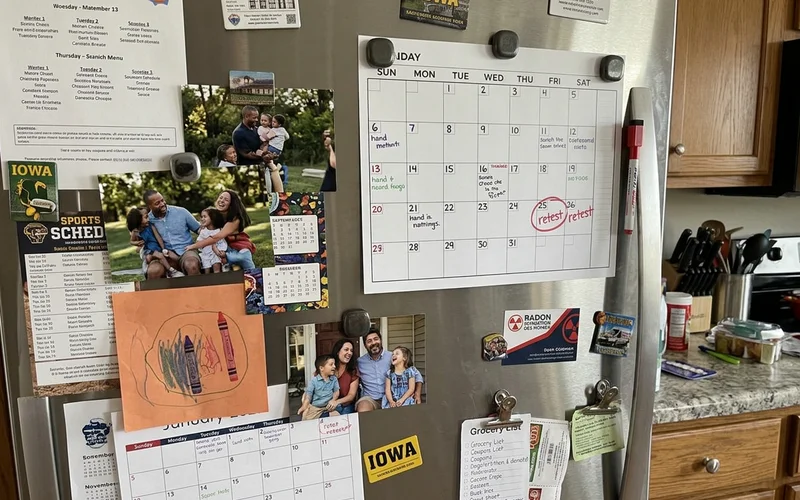
Put your next retest on the calendar the day you get your results. Many homeowners pair it with another two-year task, like a furnace check or smoke detector battery swap.
The 2.0 to 3.9 pCi/L row matters more than it looks. The EPA says to fix a home at 4 pCi/L or higher and to consider fixing between 2 and 4, because no level is known to be safe.
Sellers feel the paperwork side too. Iowa’s standard seller disclosure form asks whether any radon test is known, plus the date and result of the last report. An old number follows you into the sale.
Business owners can look at the child care rule for a benchmark. Iowa HHS requires licensed child care centers to test within one year of opening and to fix levels above 4.0 pCi/L.
Retesting When You Have a System
Retest every two years even with a system, and check your manometer every month. A radon system protects you only while it’s running and sealed.
Fans run 24 hours a day and eventually wear out. Other things can fail too:
- Rubber couplings can crack.
- Sump lids get removed for pump service and not resealed.
- New cracks can open in the slab.
- A tripped breaker can shut the fan off without anyone noticing.
The manometer is the clear U-shaped gauge on the pipe. If the liquid levels are uneven, the fan is pulling suction. If they’re even, the system isn’t working and needs service.
A manometer shows suction, not radon level. A retest every two years is still the real proof. Our maintenance team can inspect systems installed by any company.
Catching a failing fan early saves money. Angi puts a typical fan replacement around $350, versus roughly $1,000 for a full system replacement. Angi also notes that a well-maintained system can last 20 years or more, with the fan as the most delicate part. Alarm sounds, grinding noises, or low manometer readings are your cue to call.
Retesting After Renovations
Yes, retest after any renovation that touches your lowest level. Renovations are the most common reason a low result turns high.
Finishing a basement often means framing over cracks, adding a bathroom with new plumbing penetrations, or changing how air moves through the lowest level. Spending more time down there also means more exposure if levels are high. At 4 pCi/L, EPA risk estimates put lifetime lung cancer risk at about 7 in 1,000 for never-smokers and about 62 in 1,000 for smokers.
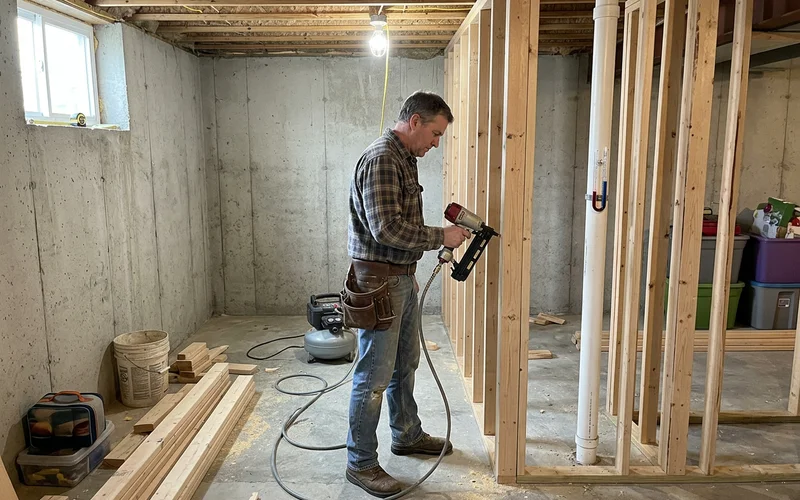
Test before you finish the basement if you can. It’s much easier to install a system while walls are still open. Then test again after the work is done.
How the Seasons Affect Your Result
Winter readings are usually the highest in Iowa, so a cold-weather test gives you the toughest case. Iowa’s seasons swing hard, and radon swings with them.
In winter, heated air rising out of your home pulls soil gas in at the bottom. That’s the stack effect, and it often makes winter readings higher. In spring, heavy rain saturates the soil and pushes gas toward your foundation. Summer readings, with windows open, are often lower. Our guide on why radon is so high in Iowa explains this in more detail.
The swing can be big. Protect Environmental, a radon firm, reported one building that read 1.8 to 2.2 pCi/L in summer and 28 to 32 pCi/L in winter. That’s an extreme case, but it shows why a single summer number can mislead you.
What this means for testing:
- A short-term test is a snapshot of a few days. It’s great for decisions on a deadline.
- A long-term test of 90 days or more averages out the seasons and gives a truer yearly number. The EPA says it’s more likely to show your year-round average.
- If a summer short-term test comes back just under 4.0 pCi/L, a winter retest or long-term test is a smart follow-up.
Testing the Right Way
Keep windows and outside doors closed for 12 hours before and during a short-term test. Wherever you are on the schedule, follow closed-house conditions.
Place the test in the lowest level you use or could use as living space, away from drafts, sump pits and outside walls. The EPA says every radon test should run at least 48 hours, whether you do it yourself or hire a tester. A cut-short test is a common reason for a result you can’t trust.
A credentialed tester handles all of this when you book a professional test, and you get a clear report with your next step. So how often should you test for radon? Every two years, plus after any change to your foundation, basement, or system. If you’re due, schedule your radon test with our Des Moines radon mitigation team and put the next date on the calendar.